 |
With the president’s signature on H.R. 3364, formally known as the Countering America's Adversaries Through Sanctions Act of 2017, the Trump administration — eager for legislative accomplishments in the wake of the GOP failure to repeal the Affordable Care Act — can take credit for turning the page on failed Obama-era policy toward the Islamic Republic of Iran.
The bipartisan passage of the long-anticipated sanctions bill by both houses of Congress allows the administration to take aim at rogue regimes in Iran, Russia and North Korea. Disagreements over U.S. policy toward Russia notwithstanding, the White House can be confident that legislators overwhelmingly support confronting threats emanating from Iran and North Korea and are prepared for even stronger measures to curtail the influence of these dangerous regimes.
The White House should now build on the successful passage of sanctions legislation to push for regime change in Tehran as an appropriate next step.
ADVERTISEMENT
The latest sanctions legislation effectively accomplishes this latter goal by extending all terror-related sanctions to the entirety of the IRGC as a Specially Designated Global Terrorist group. The question now is how far the Trump administration is willing to go to address the Iranian threat.
This question arose in June when the sanctions bill encountered delays, and it arose again in July when the White House, for a second time, certified Iranian compliance with the 2015 Joint Comprehensive Plan of Action (JCPOA). The move surprised many seasoned Iran experts familiar with Tehran’s belligerence, particularly given the president’s campaign pledges to scrap the porous agreement altogether.
In fairness to the White House, the day after certifying Iranian compliance with the Obama nuclear deal, the administration announced that it planned a thorough review of U.S. Iran policy. Some critics of the nuclear agreement believed that simply tearing it up on day one was not the best way to proceed.
But virtually all analysts agree that steps must now be taken to address the significant shortcomings of the JCPOA. The agreement’s weaknesses and omissions — the result of Obama-era eagerness to secure a deal at any cost — are well known on both sides of the aisle.
Trump’s embrace of the sanctions legislation may be an indication that he intends to adopt a more strategic policy toward Iran that would force concessions from the Islamic Republic or even encourage the transition to a new, democratic system of government.
Secretary of State Rex Tillerson previewed this possibility in June and some Iran analysts have suggested that the Trump administration’s assertive posture toward Tehran points in this direction. But Trump, Tillerson and others must now pay attention to how they plan to facilitate regime change via “elements inside Iran” to ensure a permanent solution to the nuclear issue and other matters.
The July 1 gathering in Paris of tens of thousands of Iranian expatriates committed to democratic change, supported by senior members of the president’s own party, was sufficient to remove any doubts about the likelihood of regime change being successful. It was clear to all in attendance that there is a democratic alternative to the ayatollahs and regime change is within reach.
At the Free Iran rally, Maryam Rajavi, president of the National Council of Resistance of Iran (NCRI), characterized the then-pending blacklisting of the IRGC as necessary to facilitate a domestic uprising against a weakened Iranian regime. Recent protests suggest that ordinary Iranians have tired of the regime’s civil and political repression, human rights abuses and adversarial relationship with global powers, leaving them vulnerable to a "Persian Spring."
But Rajavi emphasized that it will take more than a single package of sanctions to ensure success for the resistance movement. Now that obstacles to the IRGC’s terrorist designation have been overcome, it is time to discuss how the U.S. and its allies can further undermine Iran’s hardline paramilitary and curtail its foreign influence.
With provocative ballistic missile tests and harassment of American naval vessels in the Persian Gulf becoming a near routine occurrence, the Trump administration hardly needs a reminder of the importance of confronting the IRGC. Now the White House must decide whether it is prepared to bring an end to the regime that created the hardline paramilitary organization.
By taking assertive actions and supporting the Iranian opposition, Trump can signal not only his displeasure with JCPOA but also write the next chapter in U.S. policy toward Iran by building on the successful passage of congressional sanctions legislation.
Tehran’s rogue status and lack of legitimacy presents the White House with a unique opportunity to further isolate the Iranian regime and deny it the resources to suppress its own people the next time they rise up and demand change. The question is whether the administration is willing to seize the opportunity and push for regime change in Tehran.
Ivan Sascha Sheehan, Ph.D., is director of the graduate programs in Global Affairs & Human Security and Negotiations & Conflict Management in the School of Public and International Affairs at the University of Baltimore. Follow him on Twitter @ProfSheehan.
|
نمایش پستها با برچسب Trump، iran. نمایش همه پستها
نمایش پستها با برچسب Trump، iran. نمایش همه پستها
۱۳۹۶ مرداد ۱۶, دوشنبه
Trump sanctions set stage for necessary regime change in Iran

۱۳۹۶ خرداد ۶, شنبه
Trump’s Middle East Visit, New Alliances, and a Terrified Iran
 |
| President Donald Trump arrives in Saudi Arabia, May 20, 2017. |
State-run IRIB TV, May 22:
“The US president is hand in hand with the supporters of terrorism, human rights victimized in the dances of swords… US raises allegations against Iran to ‘milk’ Saudi Arabia, according to Foreign Minister Mohammad Javad Zarif.”MAY 26, 2017 12:03 PM0

Following Zarif’s undiplomatic and unprofessional remarks, Amir Abdullahian — an adviser to Iranian Parliament Speaker Ali Larijani and known to be close with Supreme Leader Ayatollah Ali Khamenei — provided a different perspective.
“First of all, they intend to strike a blow to the axis of resistance (read Iran’s coalition) in the region,” he said in remarks aired by IRIB TV. “This is a very important entity in the region as it has provided Iran’s utmost national security and interests.”
“This is the initiative pursue by the Saudis following the election of Mr. Trump,” Abdullahian continued. “In response to the existing Saudi Arabia, with a group of warmongering extremists at the helm, we must react with wisdom, power and force. We don’t consider Saudi Arabia as a strategic enemy. No. The Saudis lack such a capacity.”
While this senior Iranian official resorted to such claims in an effort mainly aimed at maintaining a straight face in the wake of continuous setbacks suffered by the regime, the semi-official Fars news agency, known as the Islamic Revolutionary Guard Corps’ (IRGC) mouthpiece, shed light on the regime’s true concerns over Trump’s visit to Riyadh

“The editor-in-chief of the Kayhan daily described recent remarks made by [Iranian President Hassan] Rouhani against various entities inside the Iranian government as fuel to provoke the US and the sheikhs of various Arab countries,” the piece reads. “Mr. Rouhani’s government, in its first day back in office has returned the shadows of war over our nation.”

“Despite Rouhani boasting of distancing the shadows of war from our country, the Riyadh conference, focusing on establishing an Arab NATO and sales of $110 billion in military equipment underscore how the weak actions of [Rouhani’s] cabinet not only emboldened the US to take aggressive actions against our country, even small Arab countries have reached the point of openly speaking of establishing an Arab NATO to launch a military confrontation against Iran,” the Fars piece continued.
As all elements of the Iranian regime are evaluating how to analyze and respond to the consequences of Trump’s visit to the region, the voice of the Iranian opposition welcomed the recent developments.

Maryam Rajavi — president of the National Council of Resistance of Iran (NCRI), a coalition of Iranian dissident groups leading the struggle to bring about regime change in Iran — hailed the positions adopted at the Arab-Islamic-American Summit in the face of Iran’s actions.
For nearly four decades Tehran’s measures have robbed the region, and the world over, of quiet and stability. It is time to take firm action against Iran’s terrorism and fundamentalism endeavors, its dangerous ballistic missile program and its meddling in the affairs of others. Steps similar to those embraced in the Riyadh conference are what are needed to bring a final end to terrorism, war and bloodshed, and establish peace and harmony. The recent tragic bombing in Manchester leading to the loss of too many more innocent lives was yet another reminder of the utter importance of this.
While condemning Iran’s actions and crimes is a constant necessity, practical measures, and more specifically, ending all diplomatic relations with the mullahs, expelling this regime’s delegations from international organizations, blacklisting the IRGC and other military/paramilitary/security entities associated with the government, are necessary follow-ups.

Iran’s human rights violations and the 1988 massacre of over 30,000 political prisoners, mostly members and supporters of the People’s Mojahedin Organization of Iran (PMOI/MEK), have gone ignored for far too long. This horrific dossier deserves immediate referral to the United Nations Security Council and The Hague to bring all affiliated Iranian regime officials to justice.
President Trump correctly described the Iranian people as the first victims of the mullahs’ regime. King Salman of Saudi Arabia, while delivering his respects to the Iranian nation, emphasized that ever since late regime founder Ruhollah Khomeini’s rise to power the mullahs have become the spearhead force behind global terrorism.

The ultimate solution for the current crisis engulfing the entire Middle East is regime change in Iran, carried out by the Iranian people and their organized resistance, symbolized by the NCRI.
Freedom and returning sovereignty to the Iranian people by ending the mullahs’ rule is the desire of all Iranians. Recognizing this nation’s true demand is essential to establishing peace and tranquility in the region, and indispensable to international security.
اشتراک در:
پستها (Atom)
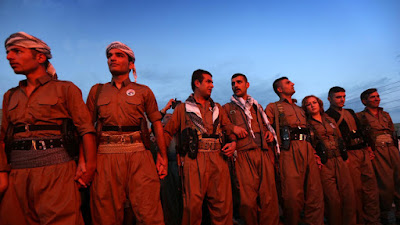
ANALYSIS: Revealing the brutal repression of Kurds in Iran
F. Mahmoudi, Special to Al Arabiya English Saturday, 9 September 2017 Acts of brutality against the Kurdish population in Iran is a ...
-
 What makes the new Iran sanctions significant? June 21, 2017 What makes the new Iran sanctions significant? ...
-
 Iran Focus London, 2 Jul - Experts and scholars, prior to participating in #FreeIran gathering, joined a panel discussion, held in P...
-
 Alireza jafarzadeh Iran Focus London, 22 Jun - The I...