 |
By Heshmat AlaviSpecial to Al Arabiya EnglishMonday, 7 August 2017
Thanks to years of Western appeasement in the face of Iran’s belligerence across the Middle East, evidence of Tehran’s dangerous footprints are now visible in several countries across the region, including even Saudi Arabia’s Eastern Province.
The Trump administration, however, has made it quite vivid its adoption of a firm approach. This stance, signaled in the historic May conference in Riyadh, is long overdue and should be enhanced by Washington supporting the Iranian people’s desire for regime change.
A history of devastation
Iran has a long record of hostility against neighboring countries and US interests in the Middle East. The 1983 bombings targeting the US Embassy and barracks in Beirut, the Khobar Towers attack in 1996, all climaxed in the support Iran provided for Shiite proxies and the Sunni Taliban in their campaign against US-led coalition forces in Afghanistan and Iraq.
In parallel form, the Lebanese Hezbollah and Hamas, two known terrorist groups, have for over 30 years enjoyed contributions from Tehran to fuel sectarianism throughout the Middle East and carry out terrorist attacks.
The Obama administration handed Iraq over to Iran in a silver plate through a strategic mistake of prematurely pulling out all US troops. This paved the path for Iran to further export its “revolution” through a convenient medium of extremist proxies.
The West can literally be accused of standing aside and watching Iran’s aggressive policy. This has rendered a slate of countries, including Afghanistan, Bahrain, Iraq, Saudi Arabia, Syria and Yemen feel threatened and/or left utterly devastated from Iran’s meddling on their soil.
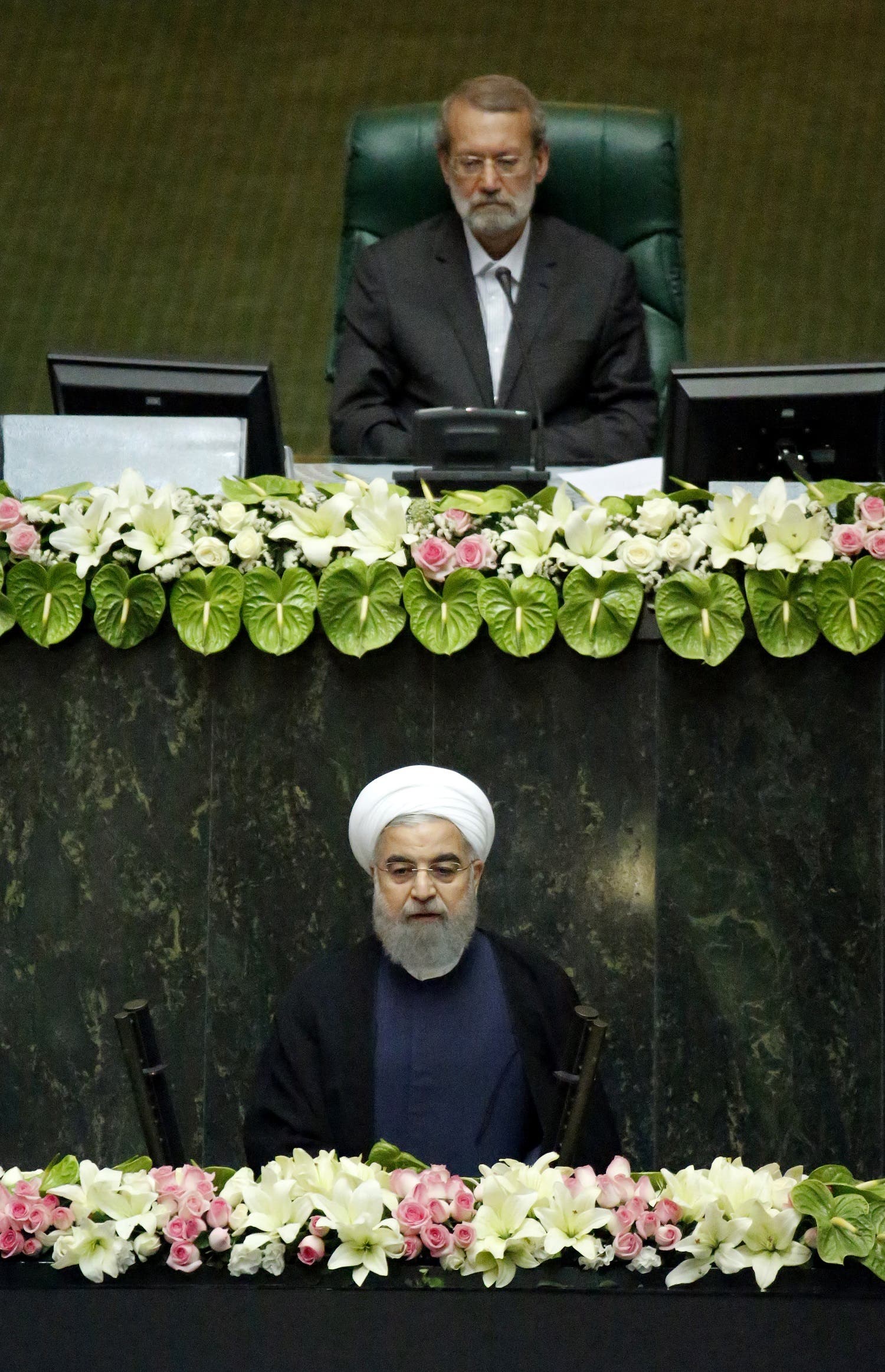
Iran’s Parliament Speaker Ali Larijani (top-R) attends President Hassan Rouhani’s swearing-in ceremony in Tehran, on August 5, 2017. (AFP)
Troubling activities
Of late, Iran has been reported to send further weapons and narcotics to Yemen’s Houthis. These drugs are sold to provide income for Iran’s supported militias on the ground in the flashpoint country south of Saudi Arabia, Tehran’s archenemy in the region.
Members of Iran’s Revolutionary Guards (IRGC) are present in Yemen also to instruct and guide the Houthis in assembling weapons smuggled into the country by Tehran.
“For the last six months the Islamic Revolutionary Guards Corps (IRGC) has begun using waters further up the Gulf between Kuwait and Iran as it looks for new ways to beat an embargo on arms shipments to fellow Shi'ites in the Houthi movement,” Reuters cited Western and Iranian sources.
“Using this new route, Iranian ships transfer equipment to smaller vessels at the top of the Gulf, where they face less scrutiny. The transshipments take place in Kuwaiti waters and in nearby international shipping lanes, the sources said.”
The Iranians are also taking provocative measures against the US Navy in the same region recently, viewed by analysts as actions to learn the limits of US President Donald Trump. On July 26th an armed Iranian patrol boat closed within less than 150 meters of the USS Thunderbolt, yielding back only in response to warning shots fired by a US Navy ship.
Such developments are reasons why Trump contacted his French counterpart Emmanuel Macron “to explore how to increase cooperation in addressing the ongoing crises in Syria and Iraq and countering Iranian malign influence,” according to a White House readout.
Positive steps forward
Despite the utterly wrong decision of EU foreign policy chief Federica Mogherini visiting Tehran for Iranian President Hassan Rouhani’s inauguration, the Trump administration is sending push-back signals and making Iran learn its aggressions will not go without cost.
This is a necessary and welcomed shift in Washington’s foreign policy.
President Trump has signed into law a strong bipartisan Congressional initiative imposing strict sanctions on Iran, Russia and North Korea. The IRGC is now considered a Specially Designated Global Terrorist group. Considering the Guards’ control over at least 40 percent of Iran’s entire economy, this raises the stakes for companies considering doing business with Tehran.
It would be wise to reconsider investing in Iran’s $400 billion economy and ponder placing one’s bets in other regional countries, or say, the United States’ $19 trillion establishment.
And in news that most certainly raised eyebrows in Tehran, Iraqi Shiite cleric Muqtada Sadr visited Saudi Arabia recently and called for the controversial Iran-backed Popular Mobilization Units in his country to be dissolved now that the Islamic State has been defeated.
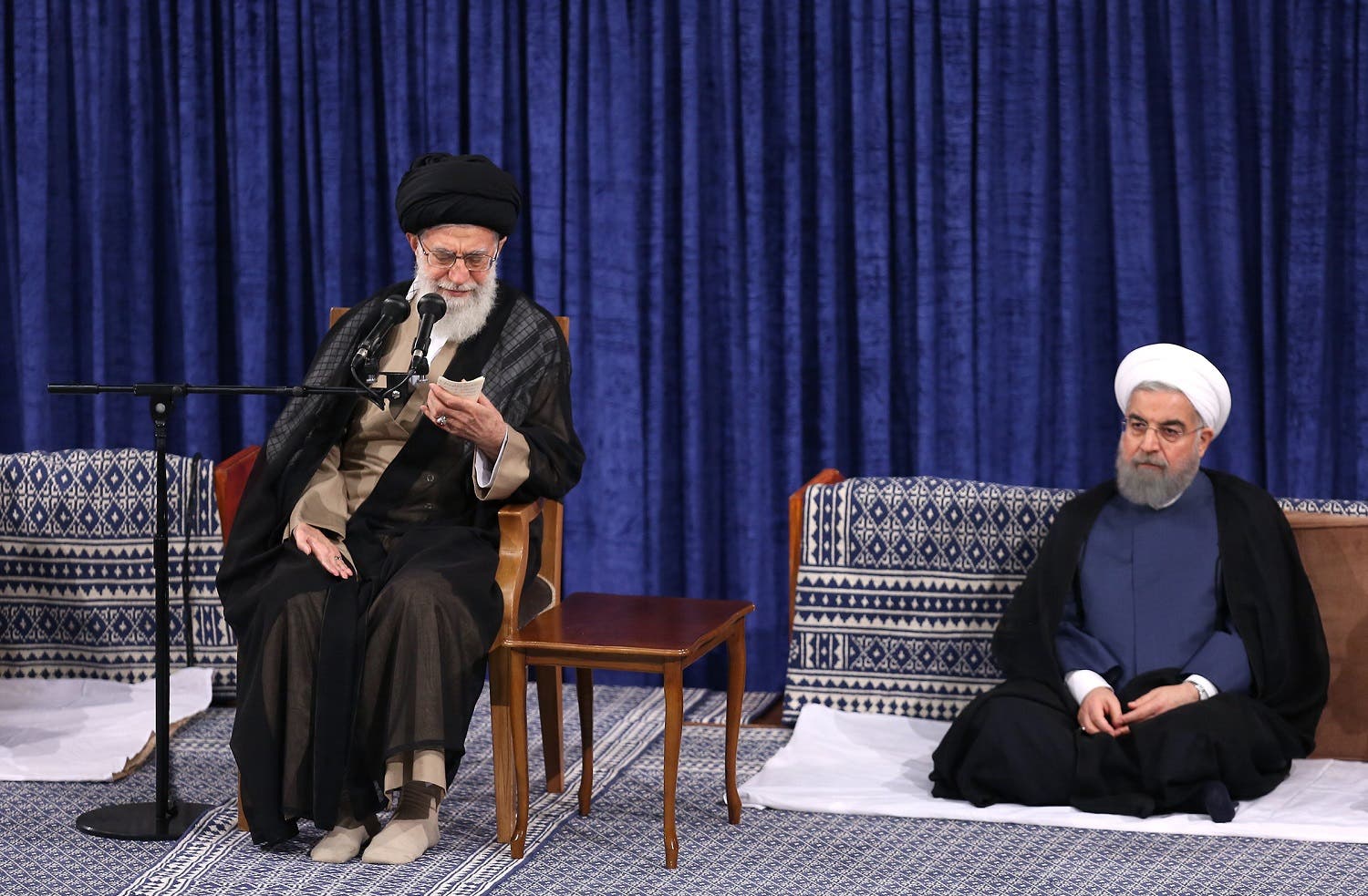
Supreme Leader Ayatollah Ali Khamenei, left, speaks in the official endorsement ceremony of President Hassan Rouhani, right, in Tehran, on Aug. 3, 2017. (AP)
The nuclear deal
High hopes were placed in the nuclear deal sealed between the P5+1 and Iran, which Obama hoped to leave behind as his foreign policy legacy.
Two years down this road it has become vivid that Iran’s behavior has not changed, to say the least. In fact, Tehran’s support for Hezbollah and other extremist entities have escalated. Iran’s role in the Middle East, namely Syria, Iraq and Yemen have been horrifically destructive.
The Trump administration can lead the international community in instituting the first real and effective initiative against the Iranian regime.
Any trade with Tehran should hinge on:
- the regime halting all executions and human rights violations,
- withdrawing their forces from Syria and Iraq, and severing any ties and support for terrorist groups, - completely stopping missile activities, especially ballistic missile production and tests, - ending all nuclear initiatives and providing true “anytime, anywhere” access to all suspected sites, including military facilities.
Moreover and parallel to recent sanctions, which must be executed immediately and without any loopholes, the Iranian people’s organized opposition, resembled in the National Council of Resistance of Iran, should be recognized. This will pave the path for regime change by this coalition without war or military intervention.
Failure in this regard is tantamount to aiding Tehran’s regime.
Last Update: Monday, 7 August 2017 KSA 08:23 - GMT 05:23
|
نمایش پستها با برچسب US. نمایش همه پستها
نمایش پستها با برچسب US. نمایش همه پستها
۱۳۹۶ مرداد ۱۶, دوشنبه
ANALYSIS: How to tackle Iran’s Middle East bellicosity
|
|
Thanks to years of Western appeasement in the face of Iran’s belligerence across the Middle East, evidence of Tehran’s dangerous footprints are now visible in several countries across the region, including even Saudi Arabia’s Eastern Province.
A history of devastationTroubling activitiesPositive steps forwardThe nuclear deal
Last Update: Monday, 7 August 2017 KSA 08:23 - GMT 05:23
|

۱۳۹۶ تیر ۲۴, شنبه
Iranian Agent of Suppression Returned to Iran
 |
| Iranian lobby, NIAC tired to prevent the deceision |



Dehnavi is an academic preparing to work at the Boston Children’s Hospital. American media published a story about his past and his active membership in the Student Basij, affiliated to the Iranian Revolutionary Guards Corps (IRGC) being the main reason for his deportation.

Earlier it was said the anti-immigration law was main reason for his arrest and entry denial into the US. He was rejected by airport border authorities.
The Student Basij, known as the Basij-e Daneshjouyi, are deployed to suppress pro-democracy students on campuses and in universities across the country.
Meanwhile, Trita Parsi, an Iranian national who runs the Washington-based National Iranian American Council (NIAC), with close ties to clerics in Iran and reportedly an active Tehran lobbyist, condemned Dehnavi’s deportation.

NIAC is also campaigning to prevent the designation of the IRGC and its entities as foreign terrorists organizations. IRGC members and proxies have been involved in murdering many US soldiers in Iraq, according to retired US generals commanding units in that country.
Dehnavi was previously an active Basij member, reports indicate, and heading the Basij unit of Tehran’s Sharif Tech University.
Dehnavi was also in charge of the students’ office of 2013 presidential candidate Saeed Jalili, according to the Associated Press. Jalili’s anti-American views were clear before and after the election.
Some former student activists at Sharif University, on the condition of not disclosing their identities to Radio Free Europe, said Dehnevi was an active Basij member who placed enormous pressure on reformist student activists. Dehnavi deserved to be deported, they said.
It seems that Dehnavi’s deportation, considering his past activities, was wise for US security, and the morale of Iranian students and professors suffering from state suppression by the Basij.
۱۳۹۶ خرداد ۶, شنبه
Trump’s Middle East Visit, New Alliances, and a Terrified Iran
 |
| President Donald Trump arrives in Saudi Arabia, May 20, 2017. |
State-run IRIB TV, May 22:
“The US president is hand in hand with the supporters of terrorism, human rights victimized in the dances of swords… US raises allegations against Iran to ‘milk’ Saudi Arabia, according to Foreign Minister Mohammad Javad Zarif.”MAY 26, 2017 12:03 PM0

Following Zarif’s undiplomatic and unprofessional remarks, Amir Abdullahian — an adviser to Iranian Parliament Speaker Ali Larijani and known to be close with Supreme Leader Ayatollah Ali Khamenei — provided a different perspective.
“First of all, they intend to strike a blow to the axis of resistance (read Iran’s coalition) in the region,” he said in remarks aired by IRIB TV. “This is a very important entity in the region as it has provided Iran’s utmost national security and interests.”
“This is the initiative pursue by the Saudis following the election of Mr. Trump,” Abdullahian continued. “In response to the existing Saudi Arabia, with a group of warmongering extremists at the helm, we must react with wisdom, power and force. We don’t consider Saudi Arabia as a strategic enemy. No. The Saudis lack such a capacity.”
While this senior Iranian official resorted to such claims in an effort mainly aimed at maintaining a straight face in the wake of continuous setbacks suffered by the regime, the semi-official Fars news agency, known as the Islamic Revolutionary Guard Corps’ (IRGC) mouthpiece, shed light on the regime’s true concerns over Trump’s visit to Riyadh

“The editor-in-chief of the Kayhan daily described recent remarks made by [Iranian President Hassan] Rouhani against various entities inside the Iranian government as fuel to provoke the US and the sheikhs of various Arab countries,” the piece reads. “Mr. Rouhani’s government, in its first day back in office has returned the shadows of war over our nation.”

“Despite Rouhani boasting of distancing the shadows of war from our country, the Riyadh conference, focusing on establishing an Arab NATO and sales of $110 billion in military equipment underscore how the weak actions of [Rouhani’s] cabinet not only emboldened the US to take aggressive actions against our country, even small Arab countries have reached the point of openly speaking of establishing an Arab NATO to launch a military confrontation against Iran,” the Fars piece continued.
As all elements of the Iranian regime are evaluating how to analyze and respond to the consequences of Trump’s visit to the region, the voice of the Iranian opposition welcomed the recent developments.

Maryam Rajavi — president of the National Council of Resistance of Iran (NCRI), a coalition of Iranian dissident groups leading the struggle to bring about regime change in Iran — hailed the positions adopted at the Arab-Islamic-American Summit in the face of Iran’s actions.
For nearly four decades Tehran’s measures have robbed the region, and the world over, of quiet and stability. It is time to take firm action against Iran’s terrorism and fundamentalism endeavors, its dangerous ballistic missile program and its meddling in the affairs of others. Steps similar to those embraced in the Riyadh conference are what are needed to bring a final end to terrorism, war and bloodshed, and establish peace and harmony. The recent tragic bombing in Manchester leading to the loss of too many more innocent lives was yet another reminder of the utter importance of this.
While condemning Iran’s actions and crimes is a constant necessity, practical measures, and more specifically, ending all diplomatic relations with the mullahs, expelling this regime’s delegations from international organizations, blacklisting the IRGC and other military/paramilitary/security entities associated with the government, are necessary follow-ups.

Iran’s human rights violations and the 1988 massacre of over 30,000 political prisoners, mostly members and supporters of the People’s Mojahedin Organization of Iran (PMOI/MEK), have gone ignored for far too long. This horrific dossier deserves immediate referral to the United Nations Security Council and The Hague to bring all affiliated Iranian regime officials to justice.
President Trump correctly described the Iranian people as the first victims of the mullahs’ regime. King Salman of Saudi Arabia, while delivering his respects to the Iranian nation, emphasized that ever since late regime founder Ruhollah Khomeini’s rise to power the mullahs have become the spearhead force behind global terrorism.

The ultimate solution for the current crisis engulfing the entire Middle East is regime change in Iran, carried out by the Iranian people and their organized resistance, symbolized by the NCRI.
Freedom and returning sovereignty to the Iranian people by ending the mullahs’ rule is the desire of all Iranians. Recognizing this nation’s true demand is essential to establishing peace and tranquility in the region, and indispensable to international security.
اشتراک در:
پستها (Atom)
ANALYSIS: Revealing the brutal repression of Kurds in Iran
F. Mahmoudi, Special to Al Arabiya English Saturday, 9 September 2017 Acts of brutality against the Kurdish population in Iran is a ...
-
 Iran Focus London, 2 Jul - Experts and scholars, prior to participating in #FreeIran gathering, joined a panel discussion, held in P...
 -
 What makes the new Iran sanctions significant? June 21, 2017 What makes the new Iran sanctions significant? ...
