نمایش پستها با برچسب iran. نمایش همه پستها
۱۳۹۶ مرداد ۲۵, چهارشنبه
۱۳۹۶ مرداد ۱۶, دوشنبه
ANALYSIS: How to tackle Iran’s Middle East bellicosity
![]() |
By Heshmat AlaviSpecial to Al Arabiya EnglishMonday, 7 August 2017
Thanks to years of Western appeasement in the face of Iran’s belligerence across the Middle East, evidence of Tehran’s dangerous footprints are now visible in several countries across the region, including even Saudi Arabia’s Eastern Province.
The Trump administration, however, has made it quite vivid its adoption of a firm approach. This stance, signaled in the historic May conference in Riyadh, is long overdue and should be enhanced by Washington supporting the Iranian people’s desire for regime change.
A history of devastation
Iran has a long record of hostility against neighboring countries and US interests in the Middle East. The 1983 bombings targeting the US Embassy and barracks in Beirut, the Khobar Towers attack in 1996, all climaxed in the support Iran provided for Shiite proxies and the Sunni Taliban in their campaign against US-led coalition forces in Afghanistan and Iraq.
In parallel form, the Lebanese Hezbollah and Hamas, two known terrorist groups, have for over 30 years enjoyed contributions from Tehran to fuel sectarianism throughout the Middle East and carry out terrorist attacks.
The Obama administration handed Iraq over to Iran in a silver plate through a strategic mistake of prematurely pulling out all US troops. This paved the path for Iran to further export its “revolution” through a convenient medium of extremist proxies.
The West can literally be accused of standing aside and watching Iran’s aggressive policy. This has rendered a slate of countries, including Afghanistan, Bahrain, Iraq, Saudi Arabia, Syria and Yemen feel threatened and/or left utterly devastated from Iran’s meddling on their soil.
![]()
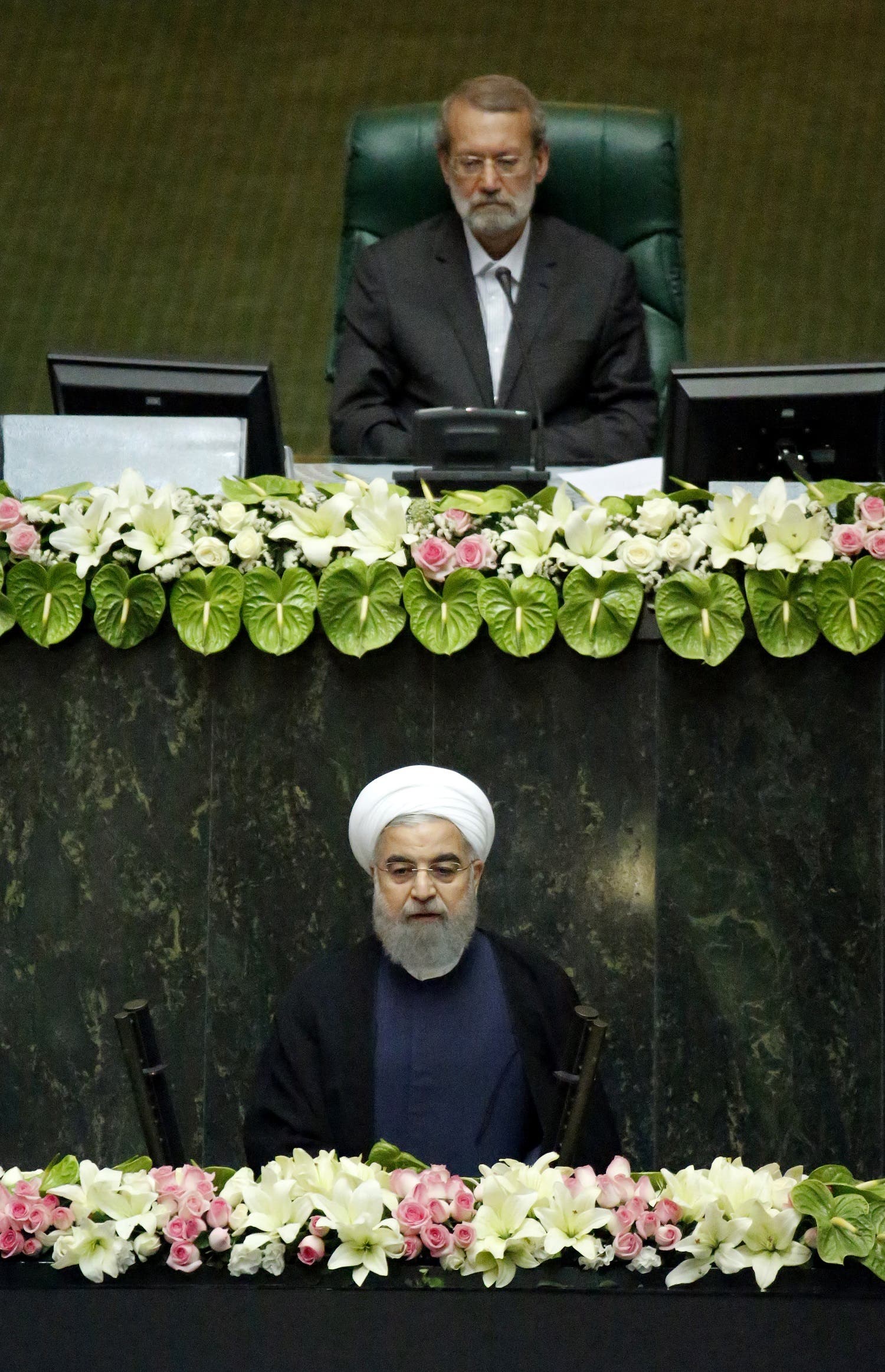
Iran’s Parliament Speaker Ali Larijani (top-R) attends President Hassan Rouhani’s swearing-in ceremony in Tehran, on August 5, 2017. (AFP)
Troubling activities
Of late, Iran has been reported to send further weapons and narcotics to Yemen’s Houthis. These drugs are sold to provide income for Iran’s supported militias on the ground in the flashpoint country south of Saudi Arabia, Tehran’s archenemy in the region.
Members of Iran’s Revolutionary Guards (IRGC) are present in Yemen also to instruct and guide the Houthis in assembling weapons smuggled into the country by Tehran.
“For the last six months the Islamic Revolutionary Guards Corps (IRGC) has begun using waters further up the Gulf between Kuwait and Iran as it looks for new ways to beat an embargo on arms shipments to fellow Shi'ites in the Houthi movement,” Reuters cited Western and Iranian sources.
“Using this new route, Iranian ships transfer equipment to smaller vessels at the top of the Gulf, where they face less scrutiny. The transshipments take place in Kuwaiti waters and in nearby international shipping lanes, the sources said.”
The Iranians are also taking provocative measures against the US Navy in the same region recently, viewed by analysts as actions to learn the limits of US President Donald Trump. On July 26th an armed Iranian patrol boat closed within less than 150 meters of the USS Thunderbolt, yielding back only in response to warning shots fired by a US Navy ship.
Such developments are reasons why Trump contacted his French counterpart Emmanuel Macron “to explore how to increase cooperation in addressing the ongoing crises in Syria and Iraq and countering Iranian malign influence,” according to a White House readout.
Positive steps forward
Despite the utterly wrong decision of EU foreign policy chief Federica Mogherini visiting Tehran for Iranian President Hassan Rouhani’s inauguration, the Trump administration is sending push-back signals and making Iran learn its aggressions will not go without cost.
This is a necessary and welcomed shift in Washington’s foreign policy.
President Trump has signed into law a strong bipartisan Congressional initiative imposing strict sanctions on Iran, Russia and North Korea. The IRGC is now considered a Specially Designated Global Terrorist group. Considering the Guards’ control over at least 40 percent of Iran’s entire economy, this raises the stakes for companies considering doing business with Tehran.
It would be wise to reconsider investing in Iran’s $400 billion economy and ponder placing one’s bets in other regional countries, or say, the United States’ $19 trillion establishment.
And in news that most certainly raised eyebrows in Tehran, Iraqi Shiite cleric Muqtada Sadr visited Saudi Arabia recently and called for the controversial Iran-backed Popular Mobilization Units in his country to be dissolved now that the Islamic State has been defeated.
![]()
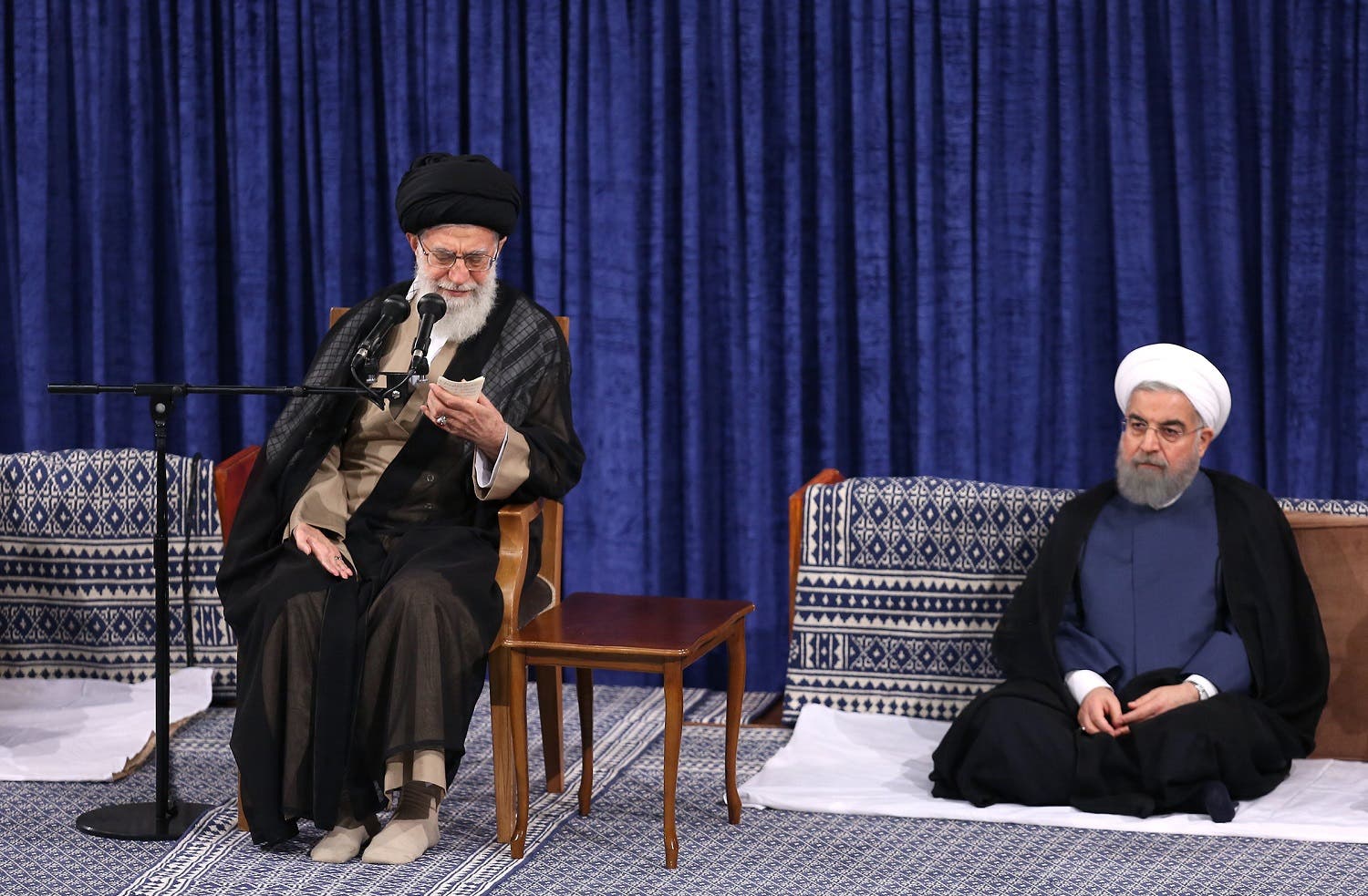
Supreme Leader Ayatollah Ali Khamenei, left, speaks in the official endorsement ceremony of President Hassan Rouhani, right, in Tehran, on Aug. 3, 2017. (AP)
The nuclear deal
High hopes were placed in the nuclear deal sealed between the P5+1 and Iran, which Obama hoped to leave behind as his foreign policy legacy.
Two years down this road it has become vivid that Iran’s behavior has not changed, to say the least. In fact, Tehran’s support for Hezbollah and other extremist entities have escalated. Iran’s role in the Middle East, namely Syria, Iraq and Yemen have been horrifically destructive.
The Trump administration can lead the international community in instituting the first real and effective initiative against the Iranian regime.
Any trade with Tehran should hinge on:
- the regime halting all executions and human rights violations,
- withdrawing their forces from Syria and Iraq, and severing any ties and support for terrorist groups, - completely stopping missile activities, especially ballistic missile production and tests, - ending all nuclear initiatives and providing true “anytime, anywhere” access to all suspected sites, including military facilities.
Moreover and parallel to recent sanctions, which must be executed immediately and without any loopholes, the Iranian people’s organized opposition, resembled in the National Council of Resistance of Iran, should be recognized. This will pave the path for regime change by this coalition without war or military intervention.
Failure in this regard is tantamount to aiding Tehran’s regime.
Last Update: Monday, 7 August 2017 KSA 08:23 - GMT 05:23
|
۱۳۹۶ مرداد ۱۱, چهارشنبه
Iranian women with college degrees earn just $40 a month
Higher education and employment have always contributed in any country to the improvement of the younger generations’ life and progress of the society as a whole.
In Iran, however, young women are victims of institutionalized discrimination in employment and education. Such discrimination has hindered their advancement to the extent that the state-run press write that women are known as “educated people who work with salaries lower than the legal minimum wage,” without insurance or official contracts.
According to an official of the Interior Ministry’s Social Security Organization Research Institute, 80 percent of uninsured job holders in Iran are women. (The state-run Khabaronline news agency, November 24, 2016)
While the poverty line in Iran is more than 3million toumans ($810), young women with college degrees have to work in unofficial jobs and under illegal contracts with monthly salaries as low as 150,000 toumans ($40).
Shahindokht Molaverdi, Rouhani’s deputy in women and family affairs acknowledged in an interview that the unemployment rate of young women in 2015 had reached the highest level in 20 years. (The state-run psychnews.ir, January 22, 2017)
The National Statistics Center of Iran declared in summer 2016 that the average unemployment rate for young women in Iran has reached 47.3 per cent last summer.
A report published by Shahrvand on June 28, 2017, shed light on this bitter reality in Iran through several interviews. Here are some excerpts:
Maryam has a BA in political sciences. She has been working in a Falafel shop for six months from 3 p.m. until midnight. She earns 150,000 toumans ($40) a month. Maryam says, “My family trusts me otherwise, it is disgraceful for a young woman in this small town to return home at midnight.”
Maryam’s job and salary are not any exception but a routine in Dehdasht and other cities and towns in Kohgiluyeh and Boyer Ahmad Province. She is one of 8 million Iranian workers who do not enjoy their minimum rights under the labor law.
Maryam says she did not enjoy her minimum rights even before finding this new job. “I worked as a secretary for two doctors, three years ago. I earned about the same amount as I do now. Of course, that job was a better and easier one. I don’t exactly know why I was laid off. I stayed unemployed for several months and then I came here.”
Shahnaz is a graduate of computer engineering. She works from 7.30 a.m. until 12.30 p.m. and then from 5 to 8 p.m. at one of the branches of a famous insurance company.
She was born and lived in Masjid Soleiman in Khuzistan Province. She earns 300,000 toumans ($80) every month. Shahnaz says, “The situation of young women’s employment in Masjid Soleiman, Dezful and Shushtar are the same. In the shop next door, my friend who has a BA in accounting works from 8.30 a.m. until 2 p.m. and then from 4 to 9 p.m. She earns 200,000 ($55) toumans a month.”
Until a year ago, Gelareh lived in a five-story doctors’ building in Sanandaj, capital of Kurdistan Province. She says, “I worked as a secretary up to last July. My contract was not legal and I did not have any insurance….
“According to the law, I must have received my unpaid salary and insurance for these years, but the Department of Labor in Sanandaj does not observe the minimum wage; they say their standard is what is paid by the job market and businesses in Sanandaj. The salary of most secretaries is about the same amount as I earn. I have not received any compensation so far by filing a complaint.”
Gelareh says filing a complaint has cost her too much. Despite having three years of experience in the medical branch, but she can no longer be employed in this section. Now she is working with her husband in different shifts of a library.
Share this post
۱۳۹۶ مرداد ۵, پنجشنبه
How blood of innocents has become an endless nightmare for Iranian regime
By F. MahmoudiSpecial to Al Arabiya EnglishThursday, 27 July 2017
In Iran, 1980s is known as a bloody decade as thousands of political opponents were executed in brutal mass murder.In the summer of 1988, a massive slaughter took place in Iran’s prisons. Ayatollah Hossein Ali Montazeri, the successor of Khomeini, was dismissed as a result of his objection to this massacre.
Montazeri
In September 2016, an audio tape from a meeting of the late Ayatollah Montazeri with members of the committee of executioners (commonly known by Iranians as death committee) was published by his son, which led to his arrest and prosecution.
In the audio tape, Ayatollah Montazeri described this massacre as the worst crime in the history of the Islamic Republic, and named Ibrahim Raisi, Mostafa Pour Mohammadi, Hossein Ali Nayeri and other coordinators as criminals.
Judgment against Islam
In a recent TV interview, Ali Fallahian, the minister of intelligence during the Rafsanjani government, said: “The view of Mr. Montazeri, who disagreed with Imam (Khomeini), was that these executions will ultimately cause a “historical judgment” against us, a judgement against Islam, so it is to our benefit not to conduct these executions, but Imam said that you must perform your religious duty and don’t wait for the judgment of history.”
The families of victims of 1988 massacre are currently seeking justice for their loved ones who were secretly executed and buried in mass graves at nights without any due process. The call for justice led by Iranian opposition, which started last year, caused a challenge for both of the regime’s factions during the presidential elections.
The created chaos between regime’s factions forced Khamenei to comment in a recent speech that “no one should be allowed to change the place of martyr and henchman in relation to the executions of the 1980s.”
What he meant was that the heads of this government are executioners in the eyes of the Iranian people, and this will create internal and international consequences that must be avoided.
Nimrooz movie
Additionally, state-controlled media released Khamenei’s praises about the “Nimrooz” movie, a production funded by the Iran revolutionary guard corps (IRGC) aimed at demonizing the People’s Mojahedin Organization of Iran (PMOI/MEK), a prominent opposition movement. The reason of making this film was to prevent another uprising similar to 2009, in which the MEK played a pivotal role in organizing protests against the regime.
After the release of the film, former political prisoners and families of executed prisoners condemned the events showed during this film and called it as a distortion of the reality in history.
In another hasty event, the Iranian regime put up a show, a tour of Evin Prison, to international delegations. The purpose of holding this tour for 50 ambassadors of different countries on July 5 was to destroy and wash the traces of the regime’s crimes. Amnesty International called this tour a “crude PR Stunt” and mentioned in a statement that Evin prison is known in the world as a symbol of wide political oppression in Iran.
The executed prisoners of the 1980s were members and supporters of opposition groups of the Iranian regime, such as the MEK, Marxists and Kurds. MEK members and supporters accounted for more than 90 percent of the victims. Beleaguered in Iraq in the post 2003 era, the MEK experienced a very difficult and dangerous situation, particularly over the last decade.
Under such circumstances this movement has been able to attract public sympathy through mass media, especially satellite and Internet. Currently, the Iranians and the International communities have become curious to acquire knowledge about this movement.
Inhuman seige
In face of an inhumane siege and the looming danger of further massacres, members of MEK put up a heroic persistence and defended themselves with bare hands and survived the many plots of their enemies. Eventually, the MEK members exited Iraq and resettled in Albania. Now, the MEK is finding a fast-growing following in Iran, especially among the youth, creating a serious challenge for the Iranian regime.
With the rise of the call for justice for 1988 massacre, the Iranian regime is trying to destroy the evidence of this brutal murder and discourage the youth from joining the opposition movement. It has produced a propaganda film to change the place of martyr and executioner, and destroyed the mass graves of executed prisoners.
The Iranian youth, even the children of regime officials, want to know the reality and the truth of what happened in the 1980s, and the history of the movement that recently held a huge gathering in Paris. Also, they want to know what message it conveys for them.
Meanwhile, Khamenei has ordered to produce another film for Assadollah Lajevardi, the former head of Evin prison known as “Evin hangman,” who was one of the criminals 1988 massacre. “Hopefully, you can do something for Lajevardi as well. He is one of the figures who deserves something. His name was mentioned in this film, but he is one of the persons that we called him ‘strong man’ before,” Khamenei said.
It seems the spilled blood of the innocents who were ruthlessly murdered in Iran is now undermining the foundations and the very existence of the Iranian regime. Sympathy for the victims and their family has now penetrated the depths of the Iranian society and has become an endless nightmare for regime.
As Rahimpour Azghadi, a Khamenei confidant has said, “the events of the ‘80s and 88 will uproot the regime, even if we have the largest missile in store.”
Last Update: Thursday, 27 July 2017 KSA 14:49 - GMT 11:49
۱۳۹۶ مرداد ۱, یکشنبه
ANALYSIS: Unveiling the secrets of Iran’s 1988 massacre
![]() |
By Heshmat AlaviSpecial to Al Arabiya EnglishSaturday, 22 July 2017
Ali Fallahian, Iran’s intelligence minister during the tenure of Rafsanjani’s presidency back in the early 90s, is a name most notoriously known for his role in a series of chain murders across the country that saw the elimination of many dissidents.
Fallahian has recently been heard making shocking revelations in reference to mass executions, especially targeting members and supporter of the Iranian opposition People’s Mojahedin Organization of Iran (PMOI/MEK).
A German court raised charges against Fallahian for his direct involvement in the September 1992 assassination of Iranian Kurdish dissidents in Berlin. In 2007, Interpol placed Fallahian on its most wanted list for his role in the 1994 bombing the AMIA in Buenos Aires Jewish center that left 85 killed.
The 1988 massacre of over 30,000 political prisoners, mostly MEK members and supporters, has in the past year inside Iran become a major issue for the general public, especially the younger generation who are beginning to demand answers.
Fallhian’s remarks, aired in a recent interview, have caused quite a stir in social media inside Iran and amongst Iranian communities living abroad. In this interview, Fallahian sheds light on his role in the Iranian regime’s die-hard enmity against the MEK as the only opposition truly threatening their rule.
|
Q: “Can we blame only the MEK for taking up arms, or did we also make mistakes… for example, attack their gatherings, pressure their members and supporters...?”
Fallahian: “They had such an analysis. [Iranian opposition leader Massoud] Rajavi had maybe written 36 articles against armed conflicts.” (Khazar website – July 18) This is Fallahian acknowledging the fact that the MEK had sought to continue their peaceful political activities. The mullahs’ regime, however, dispatched their forces to attack, arrest, torture and kill MEK members. Fallahian moves on to discuss the 1988 mass executions across Iran.
Q: “Did the Intelligence Ministry suggest the 1988 executions to [Iranian regime founder Ruhollah] Khomeini?”
Fallahian: “Khomeini himself ordered it… saying the ruling for all moharebs [term used for MEK members, meaning enemies of God] is execution. There were discussions in this regard back then. Mr. Mousavi Tabrizi believed there was no need for prosecution, arguing prosecuting those who are at war with us has no meaning. Others believed those arrested should be prosecuted… however, [Khomeini] constantly emphasized to beware they don’t slip out of your hands… [Khomeini] would always say be careful in this regard… how? For example, if there was a confusion about someone being a murderer or not, execution would not be the first option of punishment. However, about the MEK [Khomeini] would say an opposite approach is needed. I know them, he would say, they must not slip away and their rulings are execution. This was his constant ruling, before and after the 1988 issue…
“… there are discussions and some are asking why were those sentenced to prison terms again condemned to death? First of all, keep in mind their rulings are execution, even if a judge hadn’t ruled for an execution, he had violated the law… If an armed mohareb was arrested, his/her ruling would be execution, even if he/she hadn’t killed anyone… the ruling for a hypocrite (another term used for MEK members) and mohareb is execution. This was [Khomeini’s] fatwa. There was no discussion in this regard. In 1988… the discussion reached the point that all of them must be executed, even those not sentenced to death. [Khomeini] would ask why have you still kept them alive.”
It is worth noting that the Iranian opposition has for the past year launched a justice movement shedding light on the 1988 massacre both inside Iran and across the globe. These efforts went into full gear weeks prior to Iran’s May 19th presidential election, forcing Supreme Leader Ali Khamenei to sack his plans of engineering election results as he desired.
Conservative cleric Ebrahim Raisi, known to be Khamenei’s preferred candidate to replace the incumbent Hassan Rouhani as president, suffered a major defeat due to revelations of his role in the 1988 massacre. Raisi was a member of the notorious four-man “Death Commission” appointed by Khomeini himself to facilitate and hasten the execution process.
Q: “Raisi was in the commission. Who were the other members?”
Fallahian, however, refrains from naming other Death Commission members and begins discussing the process which political prisoners were executed and the summer 1988 massacre. He placed all the blame on Khomeini, emphasizing he had issued the execution and massacre ruling long before.”
Fallhian: “Yes, the poor guy [referring to Raisi] insisted he hadn’t issued the ruling, the ruling was issued in advance… but no one would listen, and they would also think the executed were innocent… if we hadn’t killed them there would be no country today. These are not my words, they are the words of [Khomeini]…”
The reporter seeks to make a reference to a groundbreaking sound file unveiled last September of Khomeini’s then successor, the late Hossein Ali Montazeri, in which he sheds light on unknown aspects of the 1988 massacre.
Q: “What was Mr. Montazeri’s mistake?”
Fallahian: “He came in disagreement with [Khomeini]… [He] believed history would judge these executions against us and Islam. He would say it would be better to refrain, as when the enemy begins to write, they won’t cite us harshly. However, [Khomeini] ordered to carry out your religious duty and don’t wait for history’s judgement.”
Q: “Were all those executed arrested while armed?”
Fallahian: “No, not all of them were involved in the armed revolt. However, many of them were living in team houses. We would go there and find only one or two weapons, or arrest them on the street without any arms.”
Q: “So how were they linked to the armed revolt?”
Fallahian: “Well, they were part of the organization.”
Q: “Wasn’t it necessary for each individual to have taken up arms to be convicted of being a mohareb?”
Fallahian: “No, when someone is a member of an armed current, the individual being armed or not, their ruling is mohareb.”
Q: “Even if they are arrested with a newspaper?”
Here the interviewer is referring to the fact that many MEK members and supporters were arrested, and eventually executed, for the mere fact of having a pro-MEK newspaper at their possession.
Fallahian: “Yes. They were part of that organization and were operational. Now, its possible someone would merely buy bread for those living in ‘team houses’, another would, for example, procure other necessary items. They were all involved.”
On a side note, Fallahian referred to the extensive MOIS role in dispatching its spies abroad under various pretexts.
Here the interviewer is referring to the fact that many MEK members and supporters were arrested, and eventually executed, for the mere fact of having a pro-MEK newspaper at their possession.
Fallahian: “Yes. They were part of that organization and were operational. Now, its possible someone would merely buy bread for those living in ‘team houses’, another would, for example, procure other necessary items. They were all involved.”
On a side note, Fallahian referred to the extensive MOIS role in dispatching its spies abroad under various pretexts.
Revelations and shocking remarks about the 1988 massacre are made by numerous senior Iranian officials recently. What has made these figures acknowledge the nature of the mullahs’ regime of carrying out such massacres and mass murders?
This has been the true, yet unfortunately cloaked, nature of the mullahs ruling Iran. Nearly three decades after that horrific summer of 1988, the efforts placed by the Iranian opposition through its vast network of brave activists inside the country and abroad have forced the mullahs to literally confess to their role in these killings.
It is now high time for the international community to demand a fact-finding mission, and bring to justice all perpetrators of the 1988 massacre and all the atrocious human rights violations throughout the past 38 years.
۱۳۹۶ تیر ۳۰, جمعه
YEARS INTO NUCLEAR DEAL, US POLICY ON IRAN NEEDS MAJOR MAKEOVER
![]() |
byAli safavi __July marks the second anniversary of the nuclear agreement between the Iranian regime and the five permanent members of the U.N. Security Council plus Germany. Former U.S. President Barack Obama envisioned the agreement — known as the Joint Comprehensive Plan of Action (JCPOA)— as a potential starting point for a broader rapprochement between the ruling theocracy and the West.
Obama had insisted that with Hassan Rouhani as the regime’s “moderate” president, Tehran would begin to exhibit a more positive behavior. Now, in his second term in office, the promise of moderation under Rouhani’s leadership has proven empty. That is because Rouhani neither wants nor is capable of reform. After all, it is not the president but the supreme leader who defines the contours of the regime’s short-term and long-term strategic direction.
That the possibility of moderation in the Iranian theocracy is a total delusion was reflected in Secretary of Defense James Mattis's recent interview with Washington state’s Mercer Island High School newspaper.
Secretary Mattis dismissed the May 19 Iranian presidential election as “not really an election” and highlighted the stark differences between the ideology of the Iranian regime and the character of the Iranian people.
Still more significant, Mattis endorsed the message that had been presented to the House Foreign Affairs Committee last month by Secretary of State Rex Tillerson. At a hearing, Tillerson suggested that American foreign policy should be focused first upon confronting the regime over its regional destabilization and then ultimately upon facilitating transition to a democratic system of government, driven by existing voices of opposition. The Defense secretary, too, reiterated that the Iranian regime is the most destabilizing force in the entire region.
After 38 years of the clerical rule in Iran, the world is beginning to understand that stability in the Middle East requires the removal of the Iranian regime, known for being the world’s foremost state sponsor of terrorism and the only full-fledged theocracy in the modern world.
While the U.S. administration has imposed new sanctions on individuals and organizations with ties to the Iranian ballistic missile program, it is now mulling the designation of the Islamic Revolutionary Guard Corps (IRGC) as a foreign terrorist organization.
By highlighting elections in Iran as a sham and also the fundamental divide between the regime and the Iranian people, Secretary Mattis did undercut much of the previous administration’s rationale for futile rapprochement with the Iranian regime.
Since the regime is both unwilling and incapable of reforming itself, democratic change at the hands of the Iranian people and their organized opposition should be recognized as the only viable option to deal with Tehran’s multi-faceted nefarious conduct. Until this situation changes, nothing else about Iran will change, not even its commitment to developing a nuclear weapon as part of its bid for regional hegemony and global influence.
This is the message that was delivered to a cheering crowd of tens of thousands of Iranians at the “Free Iran” rally in Paris on July 1 by the Iranian opposition leader Maryam Rajavi and by other international supporters of the National Council of Resistance of Iran (NCRI). Rajavi used the opportunity to urge the U.S. and its allies to formally recognize the right of the Iranian people and their organized opposition to oust the dictatorship. A democratic Iran, she added, is an imperative and is within reach. An alternative that can affect change exists.
The Free Iran rally went a long way toward showcasing the depth of Iranian people’s animosity toward the regime. Media outlets reported that the event was attended by some 100,000 people, mostly Iranian expatriates, and it featured messages from domestic dissidents and accounts of the more than 10,000 known acts of protest against the regime over the past year.
It also highlighted a flurry of activities by supporters of the NCRI and its key component, the Mujahedin-e Khalq (MEK), inside Iran who are campaigning for democracy.
Two years after the nuclear deal, it is time for a serious and comprehensive Iran policy makeover based on realities on the ground. This means designating the IRGC as a terrorist entity, expelling the Iranian regime and its proxies from the region, taking effective initiatives to permanently block the Iranian regime’s path to a nuclear bomb, and recognizing the Iranian people’s right to topple the regime and establish a democratic and peace-seeking representative government that would be the source of stability and peace in the region.
|
۱۳۹۶ تیر ۲۶, دوشنبه
Why IRGC is enemy of Islam and a major source of terroris
In 1979, after decades of oppression, people in Iran courageously stood up to the Shah dictatorship and demonstrated power of the people by toppling him. But their hopes of freedom were soon crushed when Khomeini was able to deceive them with false promises to establish a bloody reign of terror, based on a state principle called velayat-e-faqih.
,
We must not be deceived by media outlets, which try to compare Iran’s state principle to other countries in the region. Velayat-e-faqih means that the faqih, a so-called Islamic jurist, is the custodian of all Muslims until the missing 12th Imam Mahdi reappears. By nature, he must rule not only people in Iran but Muslims all over the world and has the divine duty to give global fatwas and intervene into other nations to “free” them.
This is manifested in the preamble of the Iranian constitution of 1979 when it says: “[T]he Army of the Islamic Republic of Iran and the Islamic Revolutionary Guards Corps (IRGC) […] will be responsible not only for guarding and preserving the frontiers of the country, but also for fulfilling the ideological mission of jihad in God’s way; that is, extending the sovereignty of God’s law throughout the world”.
We can see here that one main goal of IRGC is the export of “revolution” into other countries. There can never be peace as long as the whole world has been taken over by Iran’s fundamentalist interpretation of Islam. Therefore, we see that the IRGC is meddling in different countries in the region. No other country has a similar state form as Iran with the exception of ISIS.
By nature these two ideologies are similar with the difference that Iran claims to be “Shiite” while ISIS claiming to be “Sunni”. The Saudi Crown Prince therefore has every reason to say that dialogue with such a regime is impossible.
These interpretations counter the main principles of Islam which means submission and roots in the very Arabic word peace. When we take a look at the biography of Prophet Mohammad, he was always aiming to achieve peace treaties even if disadvantaging Muslims. It’s worth mentioning that Allah sent him an Ayah for victory (Quran 48:1) not after the winning of a fight but after making a peace treaty in Hudaibiyyah. These very principles are also found in the Quran which particularly aims to make people humble and loving.
Use of force
Similarly, also according to “Shiite” interpretations of Islam, Imam Ali called for the use of force only in situations of defense and only unless a necessity exists, forbidding even further violence when the enemy is injured and defenseless and from attacking innocent bystanders. This is manifested in important Shia sources such as Nahj al-Balagha.
Most “Shiite” scholars therefore reject Khomeini’s ideology and his state principle. We can therefore clearly see that the manifestation of the IRGC’s exportation of the ‘revolution’ through violence counters the very teachings of Islam. It is because of the exportation of terror through groups such as the IRGC, al-Qaeda and ISIS that many people have a wrong perception of Islam today.
These groups are therefore enemies of Islam. They misuse the banner of religion to teach anti-religious doctrines. According to the famous cleric Ayatollah Taleghani this is the most dangerous ideology possible, because here fundamentalism is justified through higher powers.
In recent years we have unfortunately seen numerous attempts to appease the Iranian regime. The Obama administration, for economic and geopolitical reasons, followed a policy of appeasement with Iran and gave them billions of dollars that were used for sectarian policies, terror and the export of its “revolution”. Even former US Secretary of State John Kerry acknowledged in an interview that Iran will use money from sanction relief for terrorism.
Qatar also helps Iran when it stroke deals and held meetings with notorious IRGC Commander Qassem Suleimani as recently in Baghdad and by spreading a pro-Iranian narrative on Al Jazeera. Therefore among other reasons Qatar is rightfully targeted by its Gulf neighbors for its involvement in global terrorism.
Economy and IRGC
Moreover according to sources from the Iranian opposition, at least 40 percent of the economy is in the hands of the IRGC. Thence many economic deals with Iran will in the end have no other result than the strengthening of the IRGC and the export of terrorism. Iran’s involvement in terror,
assassinations and cooperation with terror groups such as Al Qaeda is well documented and was even mentioned by US President Donald Trump.
Donald Trump
These failed policies of appeasement have endangered the Middle East and were a main cause for the birth of so-called ISIS. When Iran’s sectarian forces started to massacre the ‘Sunni’ community in Iraq and Syria with help from their governments, many ‘Sunnis’ by nature became more extreme and wanted to retaliate.
According to former US Ambassador to Iraq James Jeffrey, the positions and policies adopted by former Iraqi PM Maliki against Iraq’s Sunni community paved the path for the rise and growth of ISIS. Moreover, in a Fox News interview in November 2014, John Kerry acknowledged how Assad facilitated the release of 1,500 extremist prisoners which parallel to the release of 1,000 prisoners by Maliki in Iraq led to the foundation of ISIS.
To stop fundamentalism and sectarianism in the region, it is important to target the ultimate cause of instability. That can only happen when the international community places the IRGC on its terror lists and starts to confront it.
Western governments must no longer listen to corporations and lobbyists who try to benefit from instability but must help the rising people in Iran to topple the anti-religious regime. This will be a huge step to replace the darkness of terror that has taken hostage the people of the Middle East with the bright light of a new dawn of peace, the ultimate aim of Islam.
اشتراک در:
پستها (Atom)
ANALYSIS: Revealing the brutal repression of Kurds in Iran
F. Mahmoudi, Special to Al Arabiya English Saturday, 9 September 2017 Acts of brutality against the Kurdish population in Iran is a ...
-
Iran Focus London, 2 Jul - Experts and scholars, prior to participating in #FreeIran gathering, joined a panel discussion, held in P...
-
What makes the new Iran sanctions significant? June 21, 2017 What makes the new Iran sanctions significant? ...
-
June 22, 2017 Iran's missile program stepped up after nuclear deal By Shahriar Kia Less than a week after the U.S. Senate...